
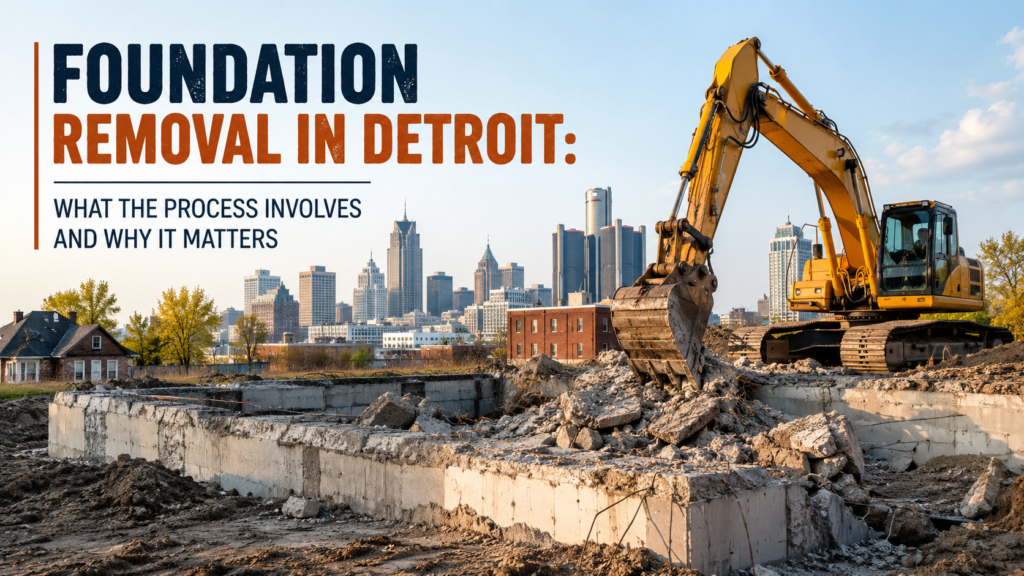
When a building is demolished in Detroit, the work is rarely finished when the walls come down. The foundation the concrete, block, or stone structure that once anchored the building to the earth must also be excavated and removed before the site can be truly cleared for new construction or landscaping. Foundation Removal Detroit is a distinct phase of demolition work that requires specific equipment, careful planning, and an understanding of subsurface conditions. In Detroit and Southeast Michigan, where the building stock ranges from late-19th-century masonry structures to mid-century residential construction to modern commercial buildings, foundation removal is a routine but technically demanding part of comprehensive site clearance.
What Is Foundation Removal?
Foundation removal is the excavation and extraction of all below-grade structural elements remaining after a building has been demolished at grade. This includes concrete foundation walls, concrete or block stem walls, concrete slabs, footings, piers, and any other structural elements embedded in the ground. Depending on the building type and age, foundations may extend anywhere from a few inches below grade for a simple slab-on-grade to 8 feet or more below grade for a full basement.
Detroit’s residential building stock includes a substantial number of older homes with full basements a practical design choice in Michigan’s climate, where frost depths require foundations to extend below the freeze line (typically 42 inches or more in Southeast Michigan). These full basement foundations present the most substantial removal scope, involving significant excavation, concrete breaking, and material hauling. Slab-on-grade foundations, more common in commercial construction and newer residential building, present a simpler removal scope but still require systematic breaking and removal.
Why Foundation Removal Is Necessary
Property owners and developers sometimes wonder why foundation removal is necessary if a building is being replaced or the site is being cleared for landscaping. There are several compelling practical and regulatory reasons.
For new construction, building on or near existing foundation remnants creates significant structural risk. An old foundation takes up volume that should be occupied by engineered fill or the new building’s foundation system. Old concrete embedded in the ground can create differential settlement if new fill is placed over it the concrete compresses differently than surrounding soil, causing uneven settling and potential structural damage to whatever is built above. New building codes and engineering standards require clean, properly prepared subgrade for any new structure, which means existing foundations must be fully removed and the resulting void properly backfilled and compacted.
For sites being cleared for surface uses parking, landscaping, parks, or urban agriculture buried foundation remnants create ongoing hazards. They can damage mowing equipment, interfere with utility installation, block drainage, and create uneven ground surfaces that are unsafe for human use. Detroit has invested significantly in transforming vacant lots left after residential demolition into green spaces and urban gardens, and effective preparation of these lots requires comprehensive foundation removal.
Michigan environmental regulations also address the disposal of demolished building materials. Foundation concrete and masonry must be properly removed and disposed of at permitted facilities, or in some cases can be crushed and reused as fill material within specific regulatory parameters. Professional demolition contractors are familiar with these requirements and manage disposal compliance as part of the removal scope.
The Foundation Removal Process in Detroit
Professional foundation removal in Detroit follows a systematic sequence. After the above-grade structure has been demolished and surface debris cleared, the contractor assesses the foundation scope depth, construction type, dimensions, and any unique features like piers, grade beams, or elevator pits in commercial structures.
Excavation begins with an excavator digging down along the exterior of the foundation walls to expose them fully. In Detroit’s glacial clay soils, this excavation can be challenging the clay holds firmly and requires significant excavator force, but it also maintains vertical wall stability better than sandy soils. Care must be taken to avoid undermining adjacent sidewalks, curbs, neighboring structures, or underground utilities during this perimeter excavation.
Once exposed, the concrete foundation is broken into manageable pieces using a hydraulic breaker attachment on the excavator. Modern hydraulic breakers can fracture even heavily reinforced concrete efficiently. The broken concrete is then grabbed, loaded, and removed from the excavation. Steel reinforcement (rebar) present in reinforced concrete foundations is also removed during this process steel is typically recycled through scrap metal channels.
After all concrete is removed, the excavation is inspected to confirm complete foundation removal. The resulting void is then backfilled with clean, compactable material typically crushed aggregate or engineered fill placed and compacted in controlled lifts to achieve the density needed to support future surface uses. Proper backfill and compaction is as important as the removal itself; poorly backfilled excavations will settle over time, creating depressions and drainage problems.
Foundation Removal in the Context of Detroit Demolition
Detroit has undertaken one of the largest urban demolition programs in American history through its Proposal N initiative, which targeted over 8,000 vacant and blighted residential structures for demolition. Each of these demolitions, when completed to a full site clearance standard, includes foundation removal. The scale of this program has made Detroit a center of expertise in systematic residential demolition and foundation clearance, with established protocols for survey, hazardous material assessment, permitting, structural demolition, foundation removal, and site restoration.
The City of Detroit requires that anyone performing demolition including foundation removal obtain an approved City of Detroit Wrecking Contractor designation and maintain state of Michigan contractor licensing. Contractors must also demonstrate proof of insurance and comply with dust monitoring requirements during demolition activity. Asbestos inspection and abatement must precede demolition for any structure that may contain regulated materials.
Michigan-Specific Considerations for Foundation Removal
Detroit’s geology primarily glacial clay soils with occasional pockets of sand or organic material creates specific conditions for foundation excavation. The clay holds shape well in open excavations, which is advantageous for foundation removal in tight urban settings. However, clay also becomes very difficult to work when saturated with water, which is a realistic condition in Detroit given the area’s substantial annual precipitation and high water tables in some neighborhoods.
Older Detroit foundations particularly those in structures built before 1940 frequently include stone masonry foundations that predate poured concrete construction. These rubble stone or brick foundations require different breaking techniques than modern reinforced concrete and produce different waste material streams. Some older foundations also incorporate materials that may require special handling, such as tar-impregnated materials or early insulation products.
Frequently Asked Questions About Foundation Removal in Detroit
How deep must a foundation be removed? Generally, all foundation material must be removed to a depth sufficient to allow proper backfill and compaction for the planned future use. For most sites, this means complete removal of all concrete and masonry below grade. For new construction sites, removal depth is determined by the new building’s foundation requirements.
Can the removed concrete be recycled? Yes. Concrete from foundation removal is commonly crushed and processed into recycled concrete aggregate (RCA) that can be used as base material for roads, parking areas, and other applications. In some cases, RCA may be permitted as structural fill with appropriate engineering oversight. Recycling concrete reduces disposal costs and benefits the environment.
Does the backfill need to be tested after foundation removal? For commercial and development projects, engineered backfill is typically subject to compaction testing by a geotechnical inspector to confirm it meets specification. For residential and smaller projects, experienced contractors use field assessment methods to verify adequate compaction before closing the excavation.